YIVU Corne Split 40% Mechanical Keyboard vs YIVU Corne 40% Split Mechanical Keyboard (2026): Key Differences
As an Amazon Associate we earn from qualifying purchases. Links on this page are affiliate links.
When comparing the yivu corne v4 wired split mechanical keyboard vs corne v4 1 split, you see two highly customizable 40% ergonomic options. Both models feature hot-swappable sockets, pre-lubed linear switches, and QMK/Vial firmware for deep customization. They share a similar compact footprint and wired USB-C connectivity. The main difference lies in their physical design and color. One offers a black chassis with specific ergonomic adjustments, while the other provides a white version with a columnar-staggered layout. You need to choose based on your preferred layout style and aesthetic.
Key differences
| Aspect | YIVU Corne Split 40% Mechanical Keyboard | YIVU Corne 40% Split Mechanical Keyboard |
|---|---|---|
| Color | Black | White |
| Layout Style | 3x6 Ortholinear | 3x6 Columnar Stagger |
| Firmware Support | QMK/Vial | QMK/Vial Pro |
| RGB Lighting | Standard RGB | South-facing RGB |
| Dimensions | 5.5 x 3.86 x 1.1 inches | 5.51 x 3.87 x 1.11 inches |
Which one should you choose?
Choose YIVU Corne Split 40% Mechanical Keyboard if
- You prefer a black chassis that matches a dark desk setup
- You want an ortholinear grid layout for precise finger placement
- You need a keyboard that explicitly supports independent side usage via TRS cable
Choose YIVU Corne 40% Split Mechanical Keyboard if
- You prefer a white chassis for a minimalist or light-colored desk
- You want a columnar-staggered layout that follows natural finger curves
- You want south-facing RGB lighting for better keycap compatibility
Verdict: Choose the first model if you prefer an ortholinear grid and a black finish. Pick the second model if you want a columnar-staggered layout, south-facing RGB, and a white chassis. Both offer excellent ergonomic benefits and customization through QMK/Vial.
YIVU Corne V4 vs V4.1 Comparison
Form Factor
Both models use a 40% split layout with a 3x6 columnar staggered design. The YIVU Corne Split 40% Mechanical Keyboard specifies an ortholinear layout, while the YIVU Corne 40% Split Mechanical Keyboard describes its arrangement as columnar-staggered ortholinear. This distinction highlights a focus on natural finger movement in the V4.1 model. Both allow you to adjust spacing, tilt, and rotation for ergonomic comfort. You can position each half to match your shoulder width, which helps reduce wrist pronation and strain. The physical dimensions are nearly identical, with widths around 3.86 inches and lengths near 5.5 inches. This consistency ensures similar desk footprint and portability for both units.
Switch Type
Each keyboard comes equipped with pre-lubricated linear switches. The YIVU Corne Split 40% Mechanical Keyboard notes a trigger pressure of 40g, which supports fast response and reduces finger fatigue during long typing sessions. The YIVU Corne 40% Split Mechanical Keyboard emphasizes factory pre-lubed linear switches that provide a buttery-smooth feel and consistent travel. Both support hot-swappable sockets for 3-pin and 5-pin MX-style mechanical switches, allowing you to customize the sound and feel without soldering. This shared feature means you can easily experiment with different switch types later. The pre-lubed state ensures a quiet and smooth experience right out of the box for both options.
Backlighting
Both keyboards feature RGB backlighting with per-key effects. The YIVU Corne Split 40% Mechanical Keyboard offers approximately 16.8 million colors and includes 45 preset modes like rainbow and breathing. You can adjust brightness, speed, and color through Vial. The YIVU Corne 40% Split Mechanical Keyboard highlights south-facing RGB lighting, which often improves keycap illumination uniformity. Both allow dynamic effects and real-time adjustments via the Vial GUI. This backlighting helps you identify keys in low-light environments and matches various desktop aesthetics. The availability of extensive color and effect options ensures you can tailor the lighting to your preference or workflow needs effectively.
Connectivity
Both models rely on wired USB-C connections for stability. The YIVU Corne Split 40% Mechanical Keyboard includes a 1.5-meter USB-C cable and a 28-centimeter TRS cable for linking the halves. It warns against connecting both USB ports to a computer simultaneously. The YIVU Corne 40% Split Mechanical Keyboard provides a durable Type-C host cable and an interconnect cable, emphasizing low latency and zero dropouts. Neither model lists wireless or Bluetooth capabilities. The wired approach ensures reliable performance for gaming and intensive typing. You must manage the cable connections carefully to avoid interference, particularly with the TRS cable on the first model, which does not support hot-swapping.
Compatibility
The YIVU Corne 40% Split Mechanical Keyboard explicitly states compatibility with Windows, macOS, Linux, and Android systems. This broad support makes it suitable for diverse computing environments. The YIVU Corne Split 40% Mechanical Keyboard mentions QMK/Vial programmability but does not list specific operating systems in its provided data. Both use open-source firmware for remapping and macro configuration, which generally ensures wide OS support. However, the explicit listing on the V4.1 model gives it a clearer advantage for users on multiple platforms. You can configure layers and macros in real-time using the Vial interface on both, enhancing workflow efficiency regardless of your OS.
Which YIVU Corne Should You Buy
Users needing full ortholinear grid alignment
The V4 model specifies an ortholinear layout. This grid arrangement aligns keys in straight rows and columns. You can adjust spacing and tilt to match your hands. The 3x6 column staggered design helps reduce wrist fatigue. This specific geometry suits typists who prefer the traditional ortholinear structure over other staggered options.
Developers wanting real-time QMK/Vial Pro
The V4.1 model uses QMK/Vial Pro firmware. It allows real-time remapping and macro configuration via the Vial GUI. You do not need to flash code. This setup supports complex multi-layer layouts for software developers. The real-time programmability streamlines your workflow without requiring technical flashing steps.
Gamers seeking South-facing RGB lighting
The V4.1 model features South-facing RGB lighting. This orientation directs light downward for better keycap illumination. You get per-key backlighting effects that match dark setups. The wired Type-C connection ensures low latency. This lighting design improves visibility in low light environments while maintaining a stable gaming connection.
The products compared
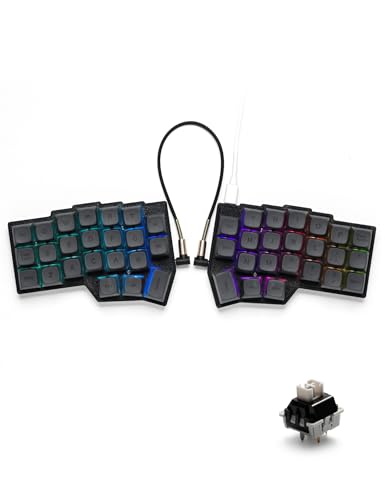
YIVU Corne Split 40% Mechanical Keyboard
Best for: Ergonomic split layout enthusiasts
- Switch Type
- Pre-lubricated linear
- Form Factor
- 40% split ortholinear
- Connectivity
- USB-C wired
- Backlighting
- RGB
- Hot-Swap Support
- Hot-Swappable
- Use
- Gaming
View on Amazon: YIVU Corne Split 40% Mechanical Keyboard Affiliate link
The YIVU Corne V4 is a 40% split ortholinear mechanical keyboard designed for ergonomic typing. It features a 3x6 columnar layout with adjustable spacing, tilt, and rotation to reduce wrist strain. The board supports hot-swappable 3/5-pin switches and includes pre-lubricated linear switches with a 40g trigger pressure. You can customize layouts via QMK/Vial and adjust RGB backlighting. It connects via USB-C wired connection.
Pros
- Adjustable split design with customizable spacing, tilt, and rotation angles.
- Hot-swappable 3/5-pin socket support for easy switch replacement.
- Full QMK/Vial programmability for custom key mapping and layers.
- 16.8 million color RGB backlighting with preset modes.
- Pre-lubricated linear switches with 40g trigger pressure for smooth typing.
Cons
- Wired-only connectivity limits wireless portability.
- TRS cable for split connection does not support hot-swapping.
- Small 40% form factor reduces available key count.
Good fit if
- You want to reduce wrist strain through an adjustable split layout.
- You prefer fully programmable keys via QMK or Vial software.
- You enjoy customizing switch types and RGB lighting effects.
Skip if
- You require wireless Bluetooth or 2.4GHz connectivity.
- You need a full-sized keyboard with numpad and function row.
- You prefer hot-swappable split cables for easy setup changes.
Verdict: YIVU Corne V4 Wired Split 40% Keyboard is a practical choice for typists seeking ergonomic benefits through an adjustable split design and full software customization. It suits users who prioritize wrist health and personalized layouts over wireless convenience.

YIVU Corne 40% Split Mechanical Keyboard
Best for: Ergonomic typing and key remapping
- Switch Type
- Pre-lubed linear
- Form Factor
- 40%
- Connectivity
- Wired Type-C
- Backlighting
- RGB
- Hot-Swap Support
- Hot-Swappable
- Design
- Ergonomic
View on Amazon: YIVU Corne 40% Split Mechanical Keyboard Affiliate link
This split 40% keyboard uses a columnar stagger layout to align keys with your fingers' natural movement. You get hot-swappable sockets for easy switch changes and pre-lubed linear switches for smooth typing. QMK/Vial firmware lets you remap keys in real time without coding. The wired Type-C connection ensures low latency. It includes south-facing RGB backlighting and works with Windows, macOS, Linux, and Android.
Pros
- Split 40% 3x6 columnar stagger layout reduces wrist strain
- Hot-swappable sockets support 3-pin and 5-pin MX-style switches
- QMK/Vial firmware allows real-time remapping and macro setup
- Pre-lubed linear switches provide smooth keypresses out of the box
- South-facing RGB backlighting matches various desktop setups
Cons
- Wired Type-C connection limits mobility compared to wireless options
- 40% layout lacks dedicated function and navigation keys
- Split design requires more desk width for shoulder-width positioning
Good fit if
- You want to reduce wrist and shoulder strain during long typing sessions
- You need real-time key remapping without flashing code
- You prefer customizable switches with pre-lubed smoothness
Skip if
- You require a wireless or Bluetooth connection for mobility
- You need a full-sized keyboard with dedicated navigation keys
- You prefer a non-split, traditional keyboard layout
Verdict: YIVU Corne V4.1 Split 40% Keyboard is a practical choice for users seeking ergonomic relief through a split columnar stagger layout and flexible firmware. It suits those who prioritize wrist health and customization over portability.
Specifications side by side
| Spec | YIVU Corne Split 40% Mechanical Keyboard | YIVU Corne 40% Split Mechanical Keyboard |
|---|---|---|
| Switch Type | Pre-lubricated linear | Pre-lubed linear |
| Form Factor | 40% split ortholinear | 40% |
| Connectivity | USB-C wired | Wired Type-C |
| Backlighting | RGB | RGB |
| Hot-Swap Support | Hot-Swappable | Hot-Swappable |
| Use | Gaming | not stated |
| Design | Ergonomic | Ergonomic |
| Color | Black | White |
| Dimensions | 5.5 × 3.86 × 1.1 inches | 5.51 × 3.87 × 1.11 inches |
Frequently asked questions
What is the main difference between the YIVU Corne V4 and V4.1 layouts?
The primary distinction lies in their key arrangements. The YIVU Corne Split 40% Mechanical Keyboard features an ortholinear layout, aligning keys in straight rows and columns. In contrast, the YIVU Corne 40% Split Mechanical Keyboard uses a columnar-staggered design. This means keys are offset vertically within columns. You should choose based on whether you prefer strict grid alignment or traditional staggered typing.
Do both keyboards support hot-swappable switches?
Yes, both models support hot-swappable sockets. This feature allows you to change switches without soldering. You can easily swap in different linear switches to adjust feel or sound. This flexibility lets you customize the typing experience to your specific preferences without needing technical tools or soldering equipment.
Are these keyboards wireless or wired only?
Both the YIVU Corne Split 40% Mechanical Keyboard and the YIVU Corne 40% Split Mechanical Keyboard are wired-only devices. They do not offer Bluetooth or 2.4GHz wireless connectivity. You must connect them via cable to your computer. This ensures a stable connection but limits portability compared to wireless alternatives.
What color options are available for each model?
The YIVU Corne Split 40% Mechanical Keyboard is available in black. The YIVU Corne 40% Split Mechanical Keyboard comes in white. These are the primary color distinctions between the two models. Both feature RGB backlighting to illuminate the keys. You should select based on your preferred aesthetic for your desk setup.
How do the physical dimensions compare between the two keyboards?
The dimensions are nearly identical. The YIVU Corne Split 40% Mechanical Keyboard measures 5.5 inches in length and 3.86 inches in width. The YIVU Corne 40% Split Mechanical Keyboard measures 5.51 inches in length and 3.87 inches in width. Both share a height of approximately 1.1 inches. The size difference is negligible for most users.
Which keyboard is better for ergonomic typing?
Both models prioritize ergonomic benefits through split designs. The YIVU Corne Split 40% Mechanical Keyboard suits users seeking full ortholinear grid alignment. The YIVU Corne 40% Split Mechanical Keyboard offers a columnar-staggered layout. Both allow you to adjust spacing and tilt. Your choice depends on whether you prefer straight rows or staggered columns for wrist health.
Can I customize the firmware on these keyboards?
Yes, both keyboards support QMK and Vial firmware. This allows for deep customization of key mappings and macros. You can remap any key to suit your workflow. This software support is a key feature for enthusiasts who want to tailor their typing experience. It applies to both the V4 and V4.1 models.
What type of switches come pre-installed?
Both keyboards come with pre-lubed linear switches. The YIVU Corne Split 40% Mechanical Keyboard specifies linear switches. The YIVU Corne 40% Split Mechanical Keyboard also uses linear switches. These provide a smooth, quiet typing action without tactile bumps. You can replace them later if you prefer a different switch type.